Quantum Optical Studies Facilities:
The quantum optical laboratory of nanostructure material and
devices laboratory (NMDL) covers instrumentations enabling a variety of spectroscopic
and microscopic characterizations including: time-integrated photoluminescence (PL)
spectroscopy, time-resolved photoluminescence, time-correlated photoluminescence
containing various interferometry such as Hanbury Brown and Twiss (HBT), unbalanced
Mach-Zehnder interferometer and Hong-Ou-Mandel (HOM) interferometer for the study of
single photon emission dynamics, correlation, and single-photon and two-photon
interference on samples with temperature ranging from 10K to room temperature.
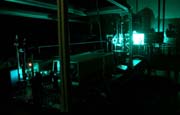
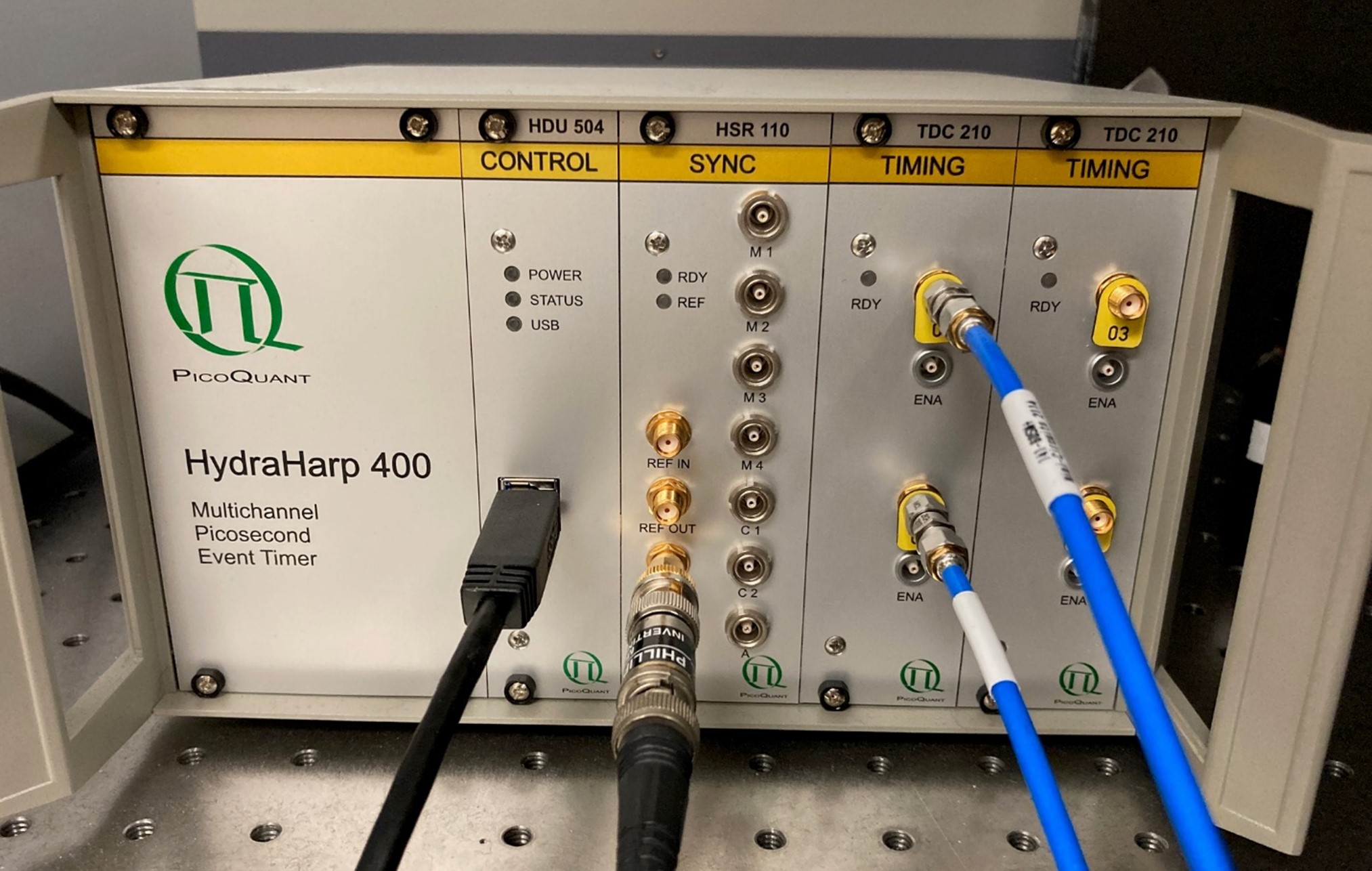
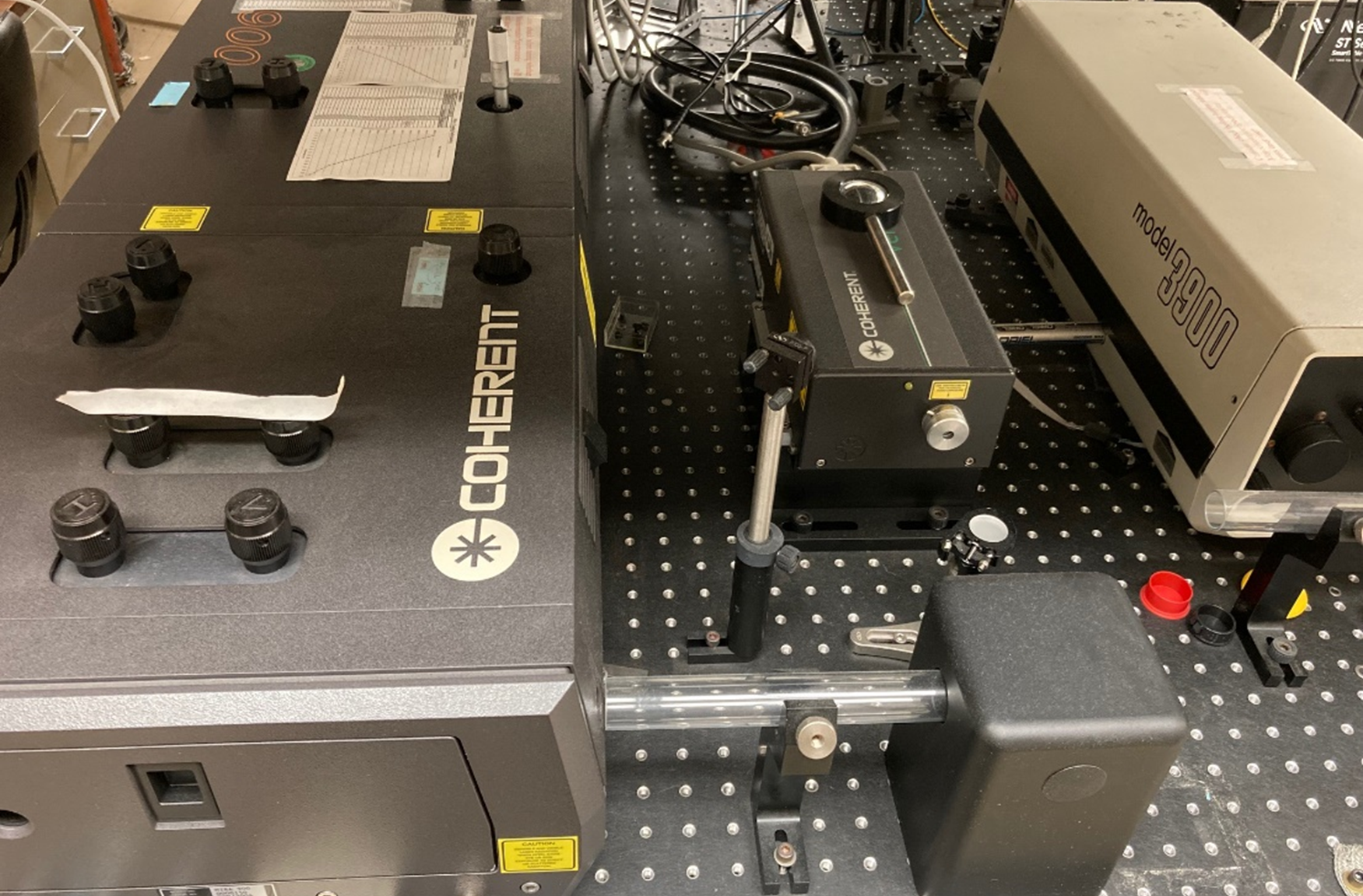
The quantum optical measurement facilities are state-of-art and home-designed. It contains
an optical pumping station including several excitation sources (diode laser, solid state
laser, Ti:S laser, lamp source etc.) covering wavelength from 700-1000nm for CW as well as
pulsed optical excitation. A microscope is built-in to the system with focal spot of ~1.2um
to allow excitation and detection of photon from each individual MTSQD. High-resolution
spectrometers of 15ueV have been integrated into the measurement facility for high resolution
studies. The time-resolved and time-correlated studies has been enabled by the integration
of superconducting nanowire detector with >80% detection efficiency around 900nm and timing
jitter of 50ps in time-correlated single-photon-counting (TCSPC) detection mechanism.
The timing resolution of our setup is ~50-100ps. A various interferometry has been included
in our facility such as Hanbury Brown and Twiss (HBT), unbalanced Mach–Zehnder interferometer
and Hong-Ou-Mandel (HOM) interferometer by combining free space optics and fiber optics.
Besides study of single photon and photon interference, a quantum tomography setup
has been built in our lab with two independent high resolution spectrometers and four
uperconducting nanowire detectors for the study of photon entanglement and entanglement
swapping with spectral resolution also of 15uev and timing resolution of 100ps.
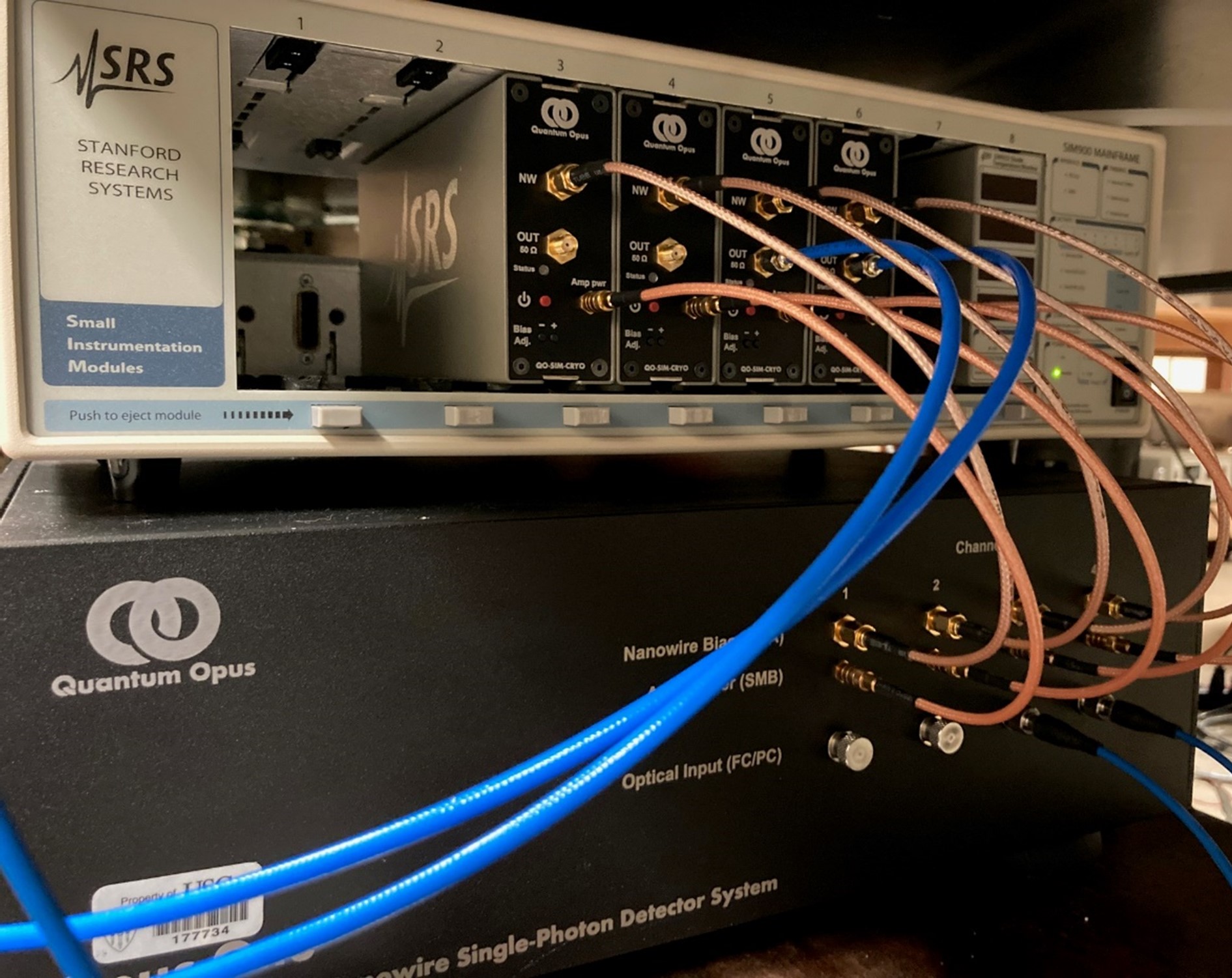
Our facility allows the aforementioned studies in both vertical(excitation)
-vertical(detection) geometry as well as horizontal(excitation)-horizontal(detection) geometry with our
custom designed cryostat providing both vertical and horizontal optical access to the sample.
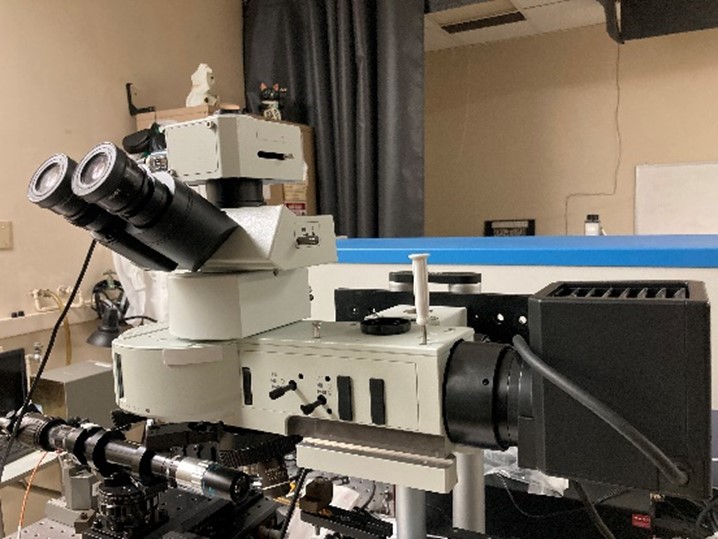
We also have an Olympus microscope-based NIR optimized imaging system integrated with our quantum optical
facilities for the direct imaging of far field radiation pattern of the MTSQDs and study of orbital angular
momentum states of single photons from MTSQDs. The imaging is achieved with an NIR optimized CCD camera.
Besides these quantum optical facilities, we also have a PL station,
also home designed, with detectors (GaAs photomultiplier tube and Ge detector etc.) for standard large
area PL and Photoluminescence excitation studies of nanostructures (Quantum wells, SAQDs, etc.). Raman
studies are also possible on this PL setup because of its f1.25m double-grating monochromator with
high stray light rejection.
Back to top