FACILITIES: NANOSTRUCTURE MATERIALS AND DEVICES LABORATORY
The NMDL has extensive facilities for the synthesis, in-situ
processing, structural, electrical, and optical characterization
of semiconductor nanostructures. Given our activity
in nanocrystal quantum dots and biochemical/ inorganic
hybrid nanostructures, facilities for the synthesis
and characterization of such materials and structures
are also available.
All UHV Interconnected Growth & In-Situ Processing, & Characterization System
We have a unique all UHV interconnected molecular beam epitaxical growth, processing,
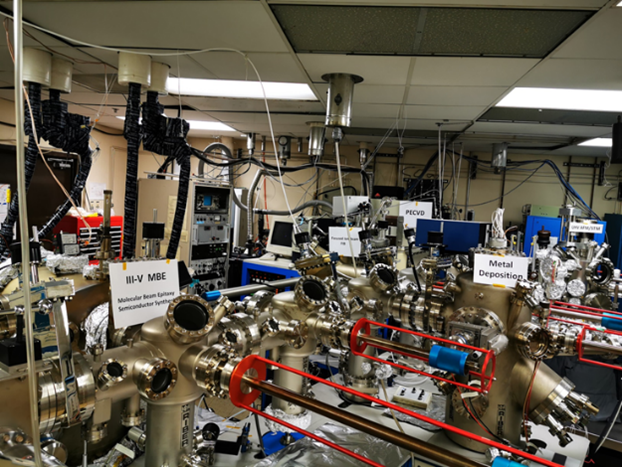
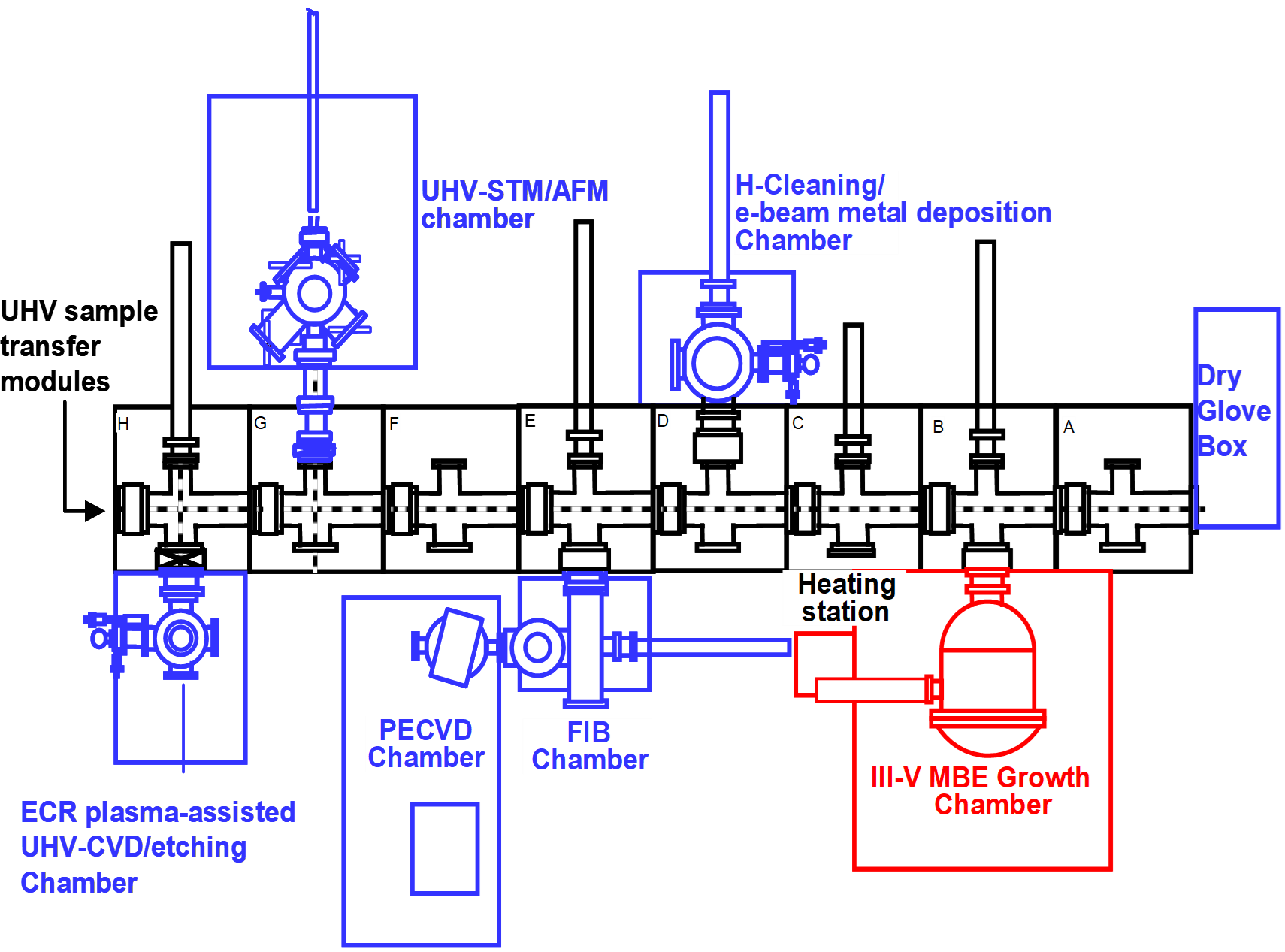
and in-situ UHV STM/AFM characterization system. A picture and schematic are shown below. This system is a 6 chamber
interconnected system comprised of (1) an MBE growth chamber for III-Vs, (2) a Fluoride MBE and metallization chamber,
(3) a plasma enhanced chemical vapor deposition (PECVD) system for dielectric deposition, (4) a focused ion beam (FIB)
system for pattern generation via ion-assisted reactive dry etching, (5) an electron cyclotron resonance (ECR)
etching system for low energy parallel etching of the semiconductor through the patterned windows opened by the
FIB, and (6) an UHV AFM/STM system for in-situ nanoscale characterization. This system has been the basis of NMDL's
work on in-situ characterization of the InGaAs/AlGaAs SAQDs and in-situ nanostructure synthesis of MTSQDs via
size-reducing growth on externally or in-situ FIB prepared mesas. Ex-situ photolithographic processing facilities
are available at the John O'Brien Nanofabrication Laboratory.
Facilities for Quantum optical studies
The quantum optical measurement facilities we have are state-of-art, suitable for
studying single photon emission, photon interference and photon entanglement as well as quantum tomography of
photons from on chip single photon emitters at temperature from 10K to room temperature (enabled by cryogen
free cryostat). Such facility has been used to study our Mesa-Top Single Quantum Dots as a new class of
on-chip spectrally uniform and spatially ordered single photon emitters.
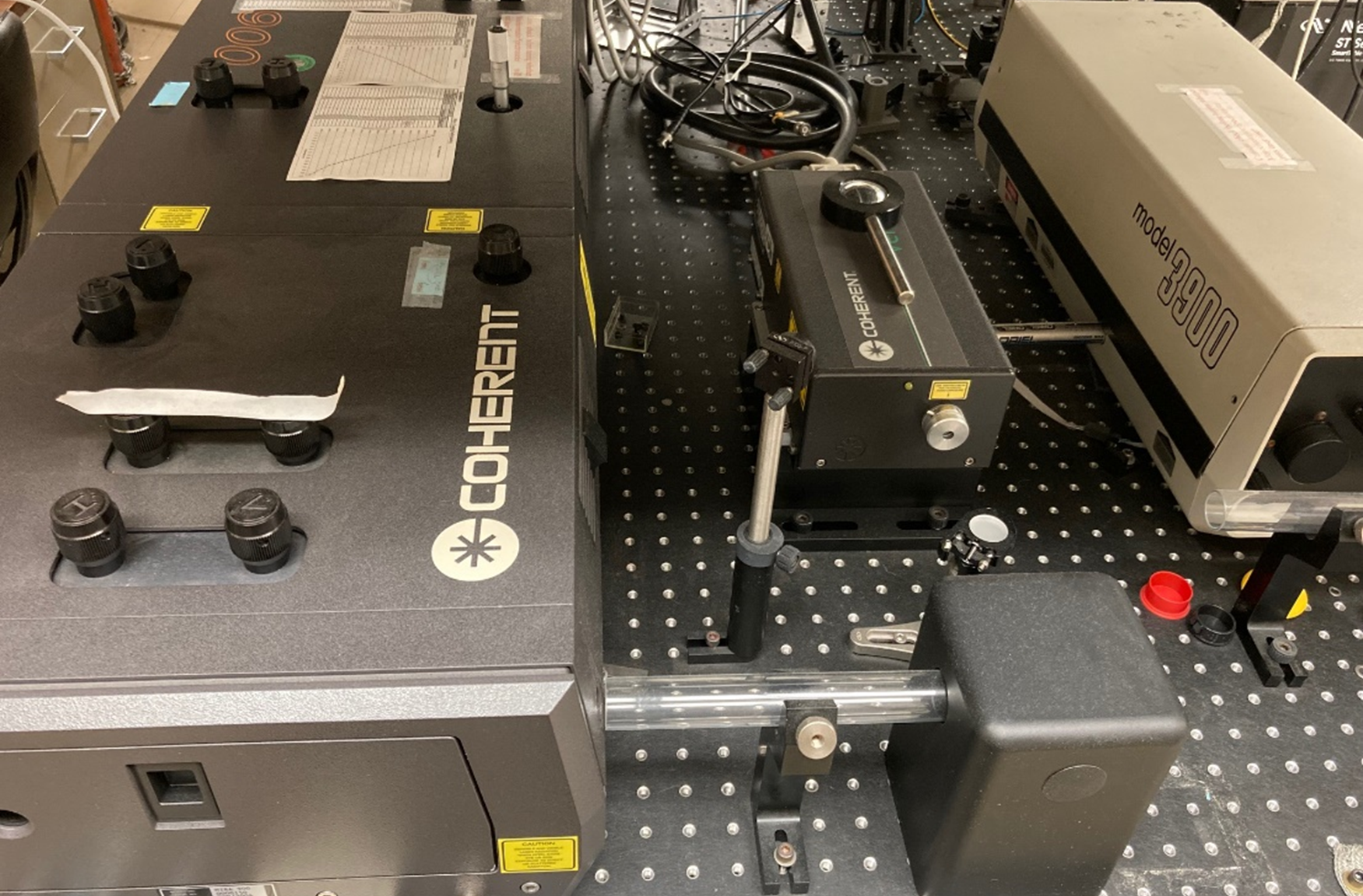
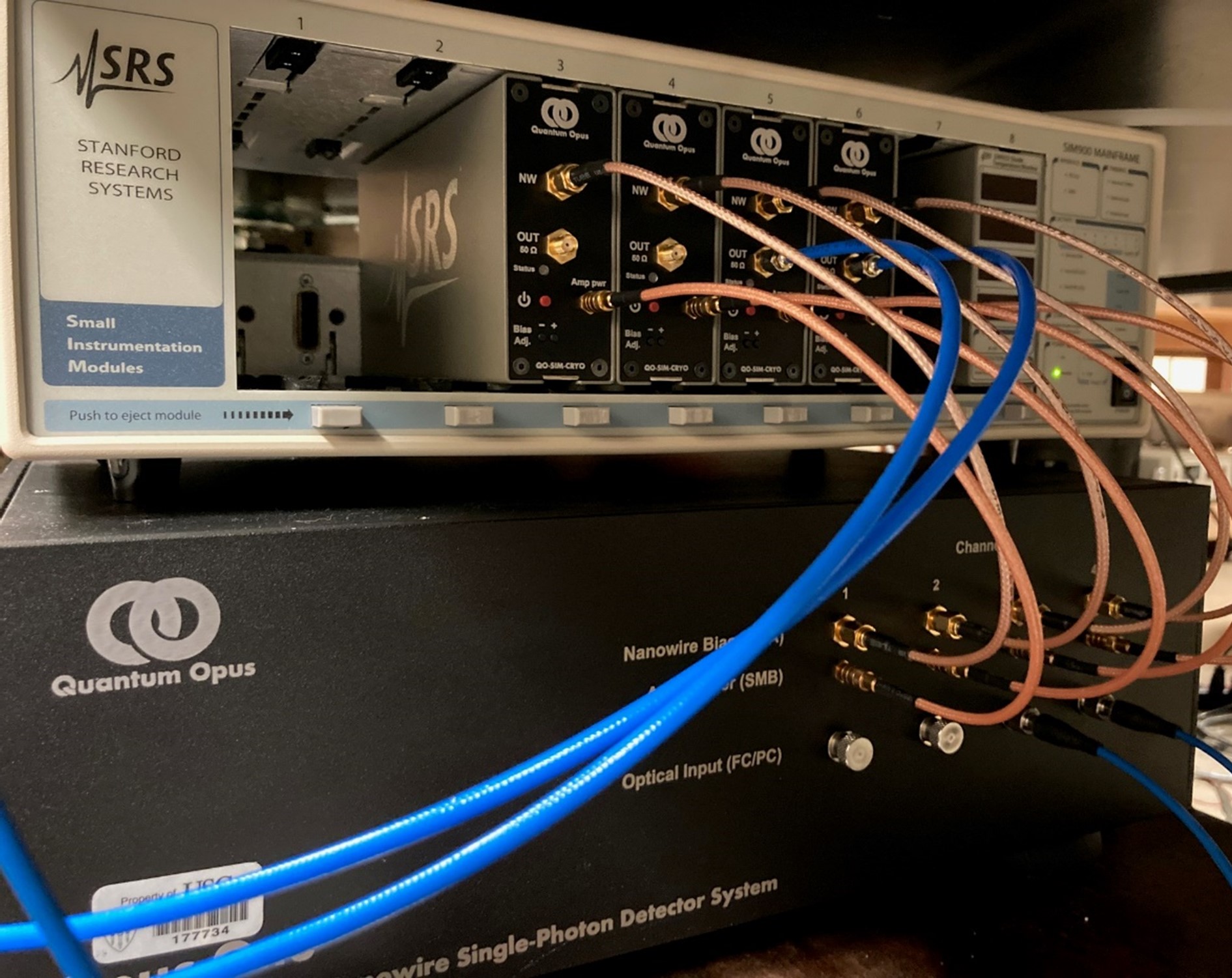
The facility contains (1) time-integrated photoluminescence with 15ueV resolution,
(2) time-resolved photoluminescence with time resolution of ~100ps along with spectral resolution of 15ueV,
(3) time-correlated photoluminescence containing both Hanbury Brown and Twiss (HBT),
(4) unbalanced Mach-Zehnder interferometer and
(5) Hong-Ou-Mandel (HOM) interferometer with timing resolution of ~100ps.
Such instrumentation enables the study of single emission dynamics, correlation,
and single-photon and two-photon interference.
The facility has also been built with an imaging system to study the far field
radiation pattern of single photon from MTSQDs for exploration of dipole orientation and orbital angular
momentum of the emitted single photon for encoding quantum information. The state-of-art facilities are
also capable of studying quantum tomography of any two to four photon states for study of photon entanglement
and entanglement swapping.
Biochemical Synthesis and Characterization
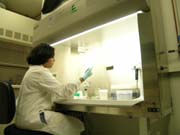
The Biochemical Nanostructure
facility of the Nanostructure Materials and Devices
Laboratory (NMDL) has the infrastructure and facilities
required for conducting various biological work, biochemical
synthesis and characterization studies. For biological
work relating to preparation and storage of various
cell lines, the facility is quite self reliant and encompasses
all the relevant equipment such as a biological safety
cabinet that provides a sterile environment for cell
culture work and manipulation of other biologically
sensitive substances, incubators needed for cell growth
during culture, an autoclave needed for sterilizing
of glassware, lab ware and media solutions, low-temperature
freezers (-80°C and -20°C) and a 4°C refrigerator
needed for the storage of competent cells, cell stocks,
peptides, antibodies, fluorescent dyes, QD chemicals
and other biological supplies. Other supporting equipment
includes a water purification system that provides ultra
high purity water, centrifuges, shakers, heat plates,
balances, etc. For biochemical work relating to synthesis
of various QDs, fluorescent markers and their bio-conjugation,
it has a Glove box that provides a controlled inert
Argon environment (< 3-4 ppm of H2O and O2) for performing
environment sensitive reactions and a Fume Hood needed
for performing other general chemical reactions. Quick
Spectroscopic characterization and analysis of various
biochemical and biological entities and constituents
is enabled by a UV-Vis spectrophotometer. In addition
to the above mentioned, it also has facilities for conducting
various protein/DNA synthesis work such as protein gel-electrophoresis
units for protein and peptide analysis, a Lyophilizer
and a speed-vacuum system for protein purification
Structural Studies
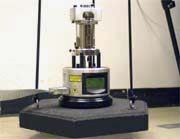
Ex-situ
structural characterization via AFM and STM (including
in liquid cell environment), and high resolution SEM
is available. Analytical and high resolution transmission
electron microscopy is available as part of central
facilities in the Center
for Electron Microscopy and Microanalysis (CEMMA).
Electrical Studies
Facilities
for Hall measurements, conductivity, tunneling, and
capacitance-voltage measurements as a function of temperature
from ~2K to ambient are available.
Back to top